The Battle That Time Forgot: Cold War Counterintelligence and the Enigma of the Soviet Military Liaison Mission by Aden C. Magee
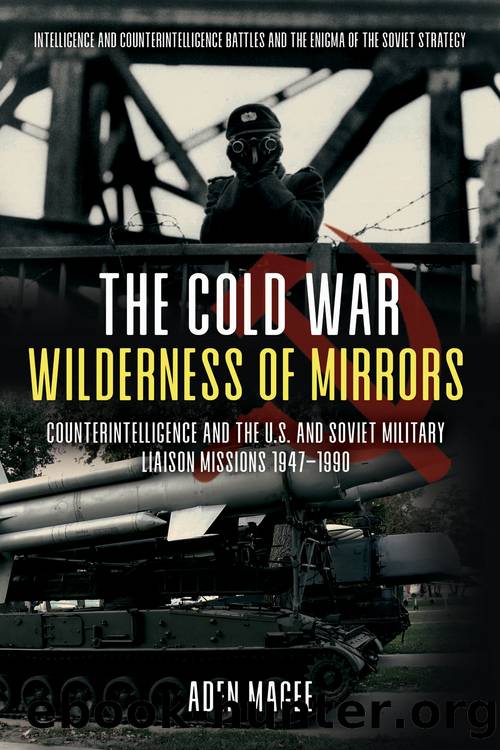
Author:Aden C. Magee [Magee, Aden C.]
Language: eng
Format: epub
Tags: Russia & the Former Soviet Union, United States, Military, Political Science, History, Intelligence & Espionage
ISBN: 9781612009933
Google: fQ8AzgEACAAJ
Goodreads: 55876815
Publisher: Casemate
Published: 2021-06-30T00:00:00+00:00
They Knew All
Intelligence reporting is classified based on the sensitivity of the information (i.e., Confidential, Secret, Top Secret). Intelligence reporting is further compartmented for limited distribution based on the sensitivity of the source of the information (e.g., Sensitive Compartmented Information (SCI), Special Category (SPECAT), Limited Distribution (LIMDIS)). The more sensitive the source, the more highly classified and compartmentalized the information will be. The reason for the more stringent classification controls is that if the information is compromised, the intelligence agency receiving the information may be able to identify and neutralize the source based on the details of the compromised information. As such, reporting based on information from a well-placed mole or highly specialized technical collection capability will be much more highly controlled than information provided by a known, overt collection platform.
HUMINT collection reporting from USMLM was generally classified Confidential or Secret with no specific restrictions on distribution, which meant the USMLM reporting was very widely disseminated. Although there was still a âneed-to-knowâ restriction, this was a relatively low threshold, and there was a broad appetite for any information involving Soviet military organization, equipment, and operations. Any element in the DoD, and particularly in USAREUR, responsible for collecting intelligence on or planning operations against the Soviet military, was a steady consumer of USMLM reporting. This was one reason why they were considered among the very most prolific sources of intelligenceâbecause their intelligence reporting was among the most widely disseminated and consumed.
Another principle of intelligence is that information collected on an adversary is only completely valuable as long as that adversary does not know the information has been collected/compromised. When the adversary is made aware that information has been collected/compromised, the information becomes less valuable; and, if the information is damaging to the adversary, it will likely be rendered of no value over time due to actions taken to mitigate the damage/risks associated with the compromised information. Unfortunately, all of the intelligence that USMLM collected for at least the final two decades of the Cold War lost its value as it applied to this intelligence principle.
In contrast to the absolute void of insider-type information regarding SMLM-F, the Soviets (or their surrogates) had multiple sources who were known to have access to all USMLM reporting, and who were proven to have provided everything they had access to. Although the known spies are recognized for significantly more damaging compromises than USMLM intelligence and collection activities, the fact remains that they provided comprehensive information applicable to USMLM for at least a 20-year period from 1969â88.
Perhaps there were even more, but there were three known spies who had access to USMLM reporting who were known to have compromised all of the information they ever had access to. Therefore, unequivocally, the Soviets knew all.
Download
This site does not store any files on its server. We only index and link to content provided by other sites. Please contact the content providers to delete copyright contents if any and email us, we'll remove relevant links or contents immediately.
Personalized inhaled bacteriophage therapy for treatment of multidrug-resistant Pseudomonas aeruginosa in cystic fibrosis by unknow(215666)
CONSORT 2025 statement: updated guideline for reporting randomized trials by unknow(102524)
Critical evaluation of the ProfiLER-02 study design and outcomes by Vivek Subbiah & Razelle Kurzrock(102053)
Cardiac gene therapy makes a comeback by Oliver J. Müller & Susanne Hille & Anca Kliesow Remes(101840)
Whisky: Malt Whiskies of Scotland (Collins Little Books) by dominic roskrow(74629)
Unveiling the design rules for tunable emission in graphene quantum dots: A high-throughput TDDFT and machine learning perspective by Şener Özönder & Mustafa Coşkun Özdemir & Caner Ünlü(51004)
A yeast-based oral therapeutic delivers immune checkpoint inhibitors to reduce intestinal tumor burden by unknow(40376)
Covalent hitchhikers guide proteins to the nucleus by Alexander F. Russell & Madeline F. Currie & Champak Chatterjee(40299)
Meet the Authors: Christopher R. Mansfield and Emily R. Derbyshire by Christopher R. Mansfield & Emily R. Derbyshire(40211)
Alkaline-earth metals promote propane dehydrogenation with carbon dioxide through geometric effects: Altering the reaction pathway by unknow(32817)
Induced iron vacancies boosting FeOOH loaded on sustainable Fenton-like collagen fiber membrane for efficient removal of emerging contaminants by unknow(32615)
Efficient electric-field-assisted photochemical conversion of methane to n-propanol exclusively over penetrated TiO2Ti hollow fibers by Guanghui Feng(32533)
Bi2SiO5 nanosheets as piezo-photocatalyst for efficient degradation of 2,4-Dichlorophenol by Hangyu Shi & Yifu Li & Lishan Zhang & Guoguan Liu & Qian Zhang & Xuan Ru & Shan Zhong(32471)
A novel NDIPTA organic heterojunction photocatalyst with built-in electric field for efficient hydrogen production by Jiahui Yang & Baojun Ma & Yongfa Zhu(32445)
Enhanced conversion of methane to liquid-phase oxygenates via hollow ferrite nanotube@horseradish peroxidase based photoenzymatic catalysis by Jun Duan & Shiying Fan & Xinyong Li & Shaomin Liu(32407)
Ordered macroporous superstructure of defective carbon adorned with tiny cobalt sulfide for selective electrocatalytic hydrogenation of cinnamaldehyde by Xiao-Shi Yuan & Sheng-Hua Zhou & San-Mei Wang & Wenbo Wei & Xiaofang Li & Xin-Tao Wu & Qi-Long Zhu(32337)
What's Done in Darkness by Kayla Perrin(27264)
Topological analysis of non-conjugated ethylene oxide cored dendrimers decorated with tetraphenylethylene: Insights from degree-based descriptors using the polynomial approach by A Theertha Nair & D Antony Xavier & Annmaria Baby & S Akhila(26636)
Investigation of mechanical and self-healing properties of hydroxyl-terminated polybutadiene functionalized with 2-ureido-4-pyrimidinone by Mohsen Kazazi & Mehran Hayaty & Ali Mousaviazar(26557)
